
The Play Crisis: Lessons from Toy Story
Updated: Jul 28
If you have children yourself or a classroom of young ones – you might very well know that the movie Toy Story 5 came out last week! If you are like me, the Toy Story movies are those guaranteed-to-ugly-cry movies that I’m first in line to see. Incredible animation and cast aside, there’s something about these movies that tug at our heart strings.
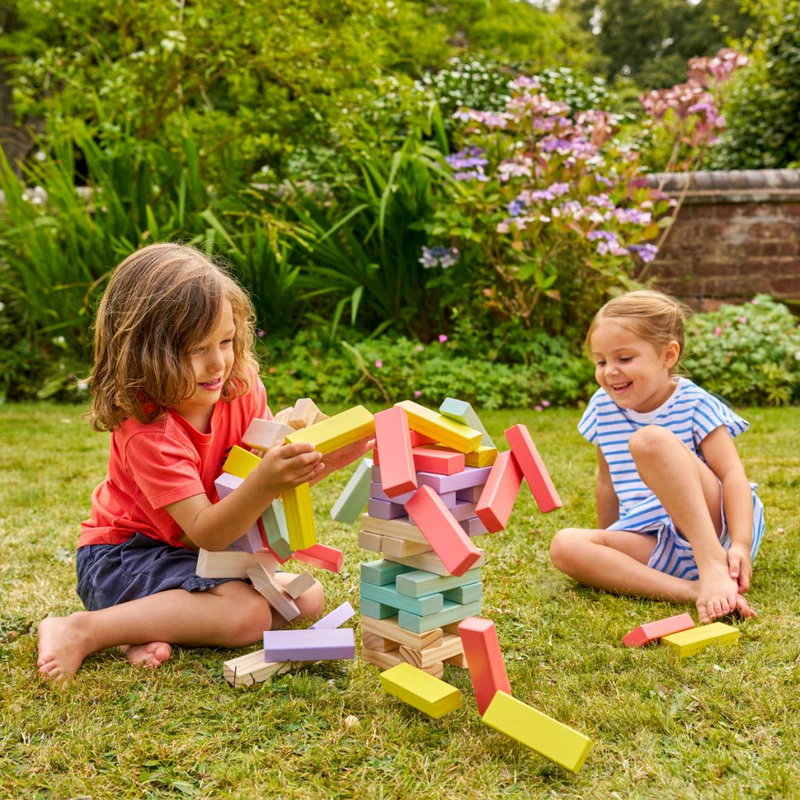
And although these movies are rife with many lessons and themes, a key one is preserving children’s sacred work of PLAY.
"Play is often talked about as if it were a relief from serious learning. But for children, play is serious learning. Play is really the work of childhood." - Fred (Mister) Rogers
If you have watched any of the movies, you will remember how sad we felt when Andy stopped playing so much with his toys – personified by the toys having existential crises because of it.
But in all seriousness, there is something very tragic about the loss of play–not just as children grow up though – but the loss as a society. The push for early “academic” readiness for Kindergarten had an unintended consequence – the early years focus moved away from play.
What Happened to Play?

Many of us – parents, caregivers, and educators – can probably reflect on the differences between our own childhood and those of children today. We were outside more, had more free time, we did more imaginary play – making mud pies and fairy villages out of the dirt and sticks in our backyards or neighbouring forests. We didn’t have technology pulling our attention away from play – spoiler, a key theme in the Toy Story 5 movie!
And at the same time, we are noticing a change in the children coming through our doors. We are seeing greater challenges with regulation, more mental health issues, and learning delays. Our Kindergarteners seem less “ready” for Kindergarten.
While there are many contributors to these findings – the loss of PLAY is one of them.
What is it about PLAY?
Play & Social Skills

Because play often happens with others, it is a natural context for developing social skills: how to navigate others’ ideas, needs, and emotions; how to take turns (which we will return to in the next sections), and even how to explore social roles and the rules of society. This is particularly true for imaginative play – when kids are pretending to be bakers, scientists, teachers, or parents – as Vygotzky put it "In play, a child is always above his average age, above his daily behavior; in play, it is as though he were a head taller than himself.” This means, rarely are children pretending to be themselves – or even someone their own age. They are stretching their skills and regulating themselves, like an adult.
Play & Executive Functions
Speaking of regulation – a perhaps hidden magic of play, is that is helps children naturally develop their executive functions – or the key brain functions for REGULATION.

Executive functions include impulse control (inhibition), working memory, and cognitive flexibility – and all of these skills are stretched and practiced within the context of play.
In a board game, children must inhibit to take turns, they must hold rules in their mind and use them (working memory), and they might have to adapt or be (cognitively) flexible with strategies, depending what happens in the game.
With imaginative play, children have to inhibit their true selves (or natural impulses) – to impersonate another character. They must remember the traits of the character and the characters of their friends, and this type of play is all about IMPROVISATION – which requires cognitive flexibility. Going with the flow of the story as it unfolds.
We didn’t realize it at the time, nor likely did our parents or teachers, but all those games and moments of playing make believe in our rooms, classrooms, or backyards were actually building our brains!
Play & Learning
Finally, speaking of classrooms, all of these benefits afforded by play contribute to learning in other areas. Learning requires attention, inhibition, creative thought, turn-taking, problem solving, and even social interaction. Thankfully, hopefully to the relief of parents of young children and early childhood educators alike, play can support the development of all of this!
CALM-ly bringing back PLAY
The good news is we already have the tools right in our childcare centres, classrooms, and homes to bring back play. Play doesn’t require elaborate or expensive toys. It requires an imagination, attentive play-partners (i.e., the big people or peers), and space (and time) to explore.

In CALM, Melvin and friends love to play through songs and games. Melvin knows games like Go-Go-Stop, Simon-Says, Memory games, Head-Shoulders, and Freeze Dance all help exercise his executive functions like Inhibition, Working Memory, and Cognitive Flexibility!

Another way that CALM encourages play is through CONNECT-ACT-REFLECT, found in the CALM K and 1 Curricula. This activity, and accompanying book, give suggestions for engaging children’s imagination and creativity to plan play together, create what is needed for play, and then reflect on the process.
Don’t Forget to Play
So, Woody and Buzz, and all the Toy Story friends, remind us to keep playing. That play evolves as kids grow up – but that even grown-ups benefit from retaining a playfulness and childlike wonder.
And, we know children are motivated by connection, feelings of competence, and sharing moments of delight and joy with their big people. What does this mean? It is an invitation to you – to KEEP PLAYING too.
"We don't stop playing because we grow old; we grow old because we stop playing." – George Bernard Shaw
For more information about CALM programs and resources, check out connectwithcalm.ca.
Selected References
Casey, T., & McKendrick, J. H. (2023). Playing through crisis: Lessons from COVID-19 on play as a fundamental right of the child. The International Journal of Human Rights, 27(9-10), 1369-1388. https://doi.org/10.1080/13642987.2022.2057962
Diamond, A., & Lee, K. (2011). Interventions shown to aid EF development in children 4 to 12 years old. Science, 333(6045), 959–964. https://doi.org/10.1126/science.1204529
Doebel, S., & Lillard, A. S. (2023). How does play foster development? A new executive function perspective. Developmental Review, 67(101064), 10-1016. https://doi.org/10.1016/j.dr.2022.101064
Veraksa, A., Sukhikh, V., Veresov, N., & Almazova, O. (2022). Which play is better? Different play types and development of executive functions in early childhood. International Journal of Early Years Education, 30(3), 560-576. https://doi.org/10.1080/09669760.2022.2091979
Vygotsky, L. S. (1978). The role of play in development. In M. Cole, V. John-Steiner, S. Scribner., & E. Souberman, (Eds.). Mind in society: Development of higher psychological processes (pp. 92–104). Cambridge: Harvard University Press. https://www.doi.com/10.2307/j.ctvjf9vz4.12


Comments